
The „Zakret” Reserve was created in 1957 on request of Prof. Wladyslaw Szafer, a famnus botanist and conservationist Initially, it covered two forest lakes with a boggy conifer forest around and a wet-ground forest with the area of 37.8 ha. In 1982, on request of Tadeusz Góralski, the inspector of the National Forests, the reserve included another lake and a part of a boggy conifer forest with the area of up to 105.3 ha.
The „Zakret” Reserve is situated about 1 km west of Krutyn, near the road to Lake Mokre.
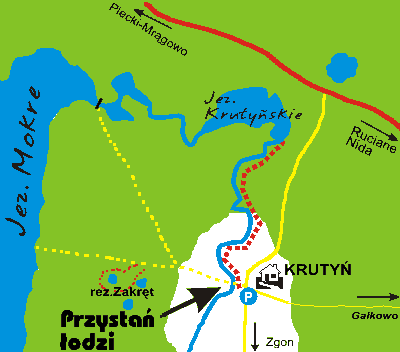
The length of the nature path – 3 km
Duration of the trip – okolo 1.5 hrs.
The path leading through the „Zakret” Reserve begins and ends in Krutyn. Behind the bridge on the Krutynia River we walk straight towards the forest. On the right we pass a former wooden forester’s lodge and then along a path through a mixed forest with prevailing pines, hornbeams and spruces. At the barrier, we pass a monumental English oak called the Krutyn Oak ( it grows on the left about 50 m from the barrier).
After we have covered 500 m through the forest, we can see a path to the reserve on the left. Here we can see a noticeboard with the path and the description of flora and fauna of the reserve. Opposite the fork of the roads grows another nature monument A Couple in Love. It is an over one-hundred-year-old oak embracing a pine with its branches like lovers do.
- In the reserve
We walk along a path and at the fork we turn right. On the left we pass a boggy trough overgrown with drying birches – (too much water). Farther the birch forest turns into a boggy forest. - Dystrophic lakes
When we come to the first lake on the left, we come across a pier that leads to the open water. Here you can admire the lake and typical peat bog plants.
The lakes fill several hundred deep pits with impermeable beds and only supplied with rain water. They are surrounded by morainal hills.
Here you can observe the lake being overgrown with peat bog plants. The lakes become overgrown from the shores towards the centres. This occurs as a result of the expansion of the coat of moss mainly consisting of peat bog moss and flowering plants. The coat sometimes gets torn as a result of frosts and winds and the coat scraps are moved across the water surface and look like island – see photo. - Flora of the reserve
You can find here typical peat bog plant species. In the central part of the lakes, near the edge of the peat bog coat, you can notice a white beak-sedge. Farther towards the centre of the peat bog you can see other species, e.g. a round-leaved sundew, a shore sedge and a rannoch rush. Of the heath family abounding in the peat bog, you can see a bog rosemary with lengthened coriaceous leaves and whitish underside, a bog cranberry with edible red fruit, a wild rosemary resembling fallen pine twigs with a typical smell, a bog billberry with berries with a thick coating, called „a lush” due to the content of a substance which causes giddiness and a cowberry occurring in external parts of the bog forest.
The bog forest is characterised by over one-hundred-year-old pines, growing low, with a small diameter, often twisted in the internal part facing the lake.
Walking farther, behind the pier on the left, we slowly go around the lake. - Fauna of the reserve
Here we will see a bird of the crow family – an Eurasian jay. These birds contributed to such a big number of young oaks. Eurasian jays, in other more fertile parts of the reserve where there are we-ground forests with splendid oaks, take out the acorns and carry them towards the peat bogs where they store them under the moss. In the reserve, there are also a few dozen other species of birds. The most interesting are: goldeneye, hazel grouse, eagle owl hunting over the lakes and green sandpiper.
There are also some mammals in the reserve. We can meet deer, wild boars, squirrels, raccoon dogs and bats – common pipistrelle and Nathusius’s pipistrelle. In the lake you can catch perch and small catfish.
After we go around the lake, along the pier along the marshy dyke and farther near the Masurian Bartny’s Oak – a nature monument, we come back to Krutyn.